IGF-1 receptor binding
IGF-1 LR3 activates the IGF-1 receptor and downstream kinase signalling.

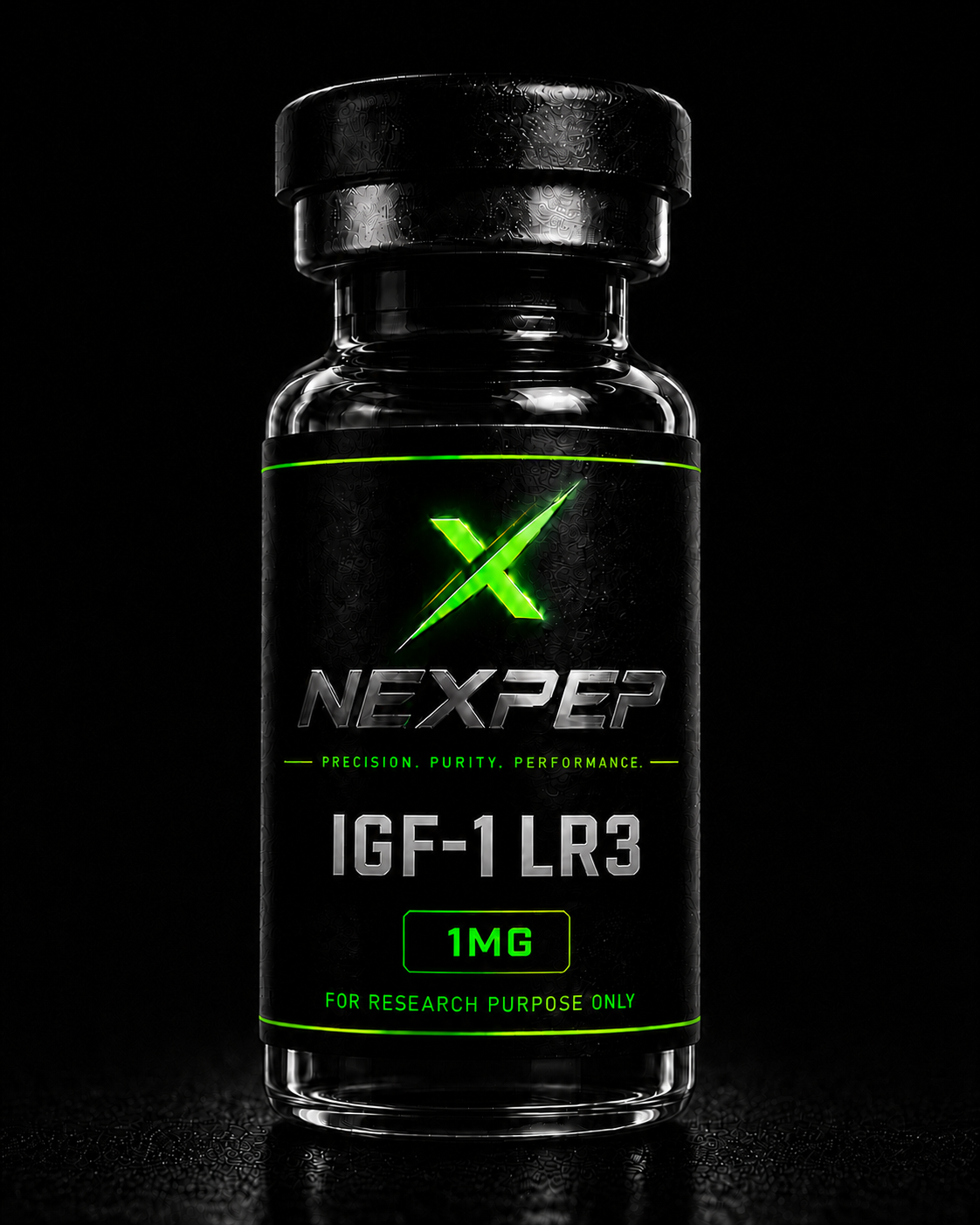
Research profile
Long-acting IGF-1 analogue research material
IGF-1 LR3 is an engineered analogue of insulin-like growth factor 1 with an Arg3 substitution and an extended amino-terminal sequence. It is used in controlled research on IGF-1 receptor signalling and reduced binding-protein affinity.
Scientific context
Research applications examine IGF-1 receptor activation, cell proliferation, survival signalling and metabolic responses. Results are highly dependent on cell type, nutrient state, concentration and exposure duration.
Mechanism map
IGF-1 LR3 activates the IGF-1 receptor and downstream kinase signalling.
Its sequence modifications reduce affinity for several IGF-binding proteins compared with native IGF-1.
Downstream growth and metabolic signals depend on model conditions and available substrates.
Study design
These are experimental design concepts—not recommendations for human use, co-administration or dosing.
Allows direct comparison of receptor signalling and binding-protein effects.
Match molar exposure rather than vial mass alone.Provides a baseline for proliferation and survival assays.
Use identical media, timing and handling.A single-agent arm avoids confounding endocrine and mitogenic signals.
Predefine stopping criteria for high-response cell models.Interpretation controls
Evidence trail